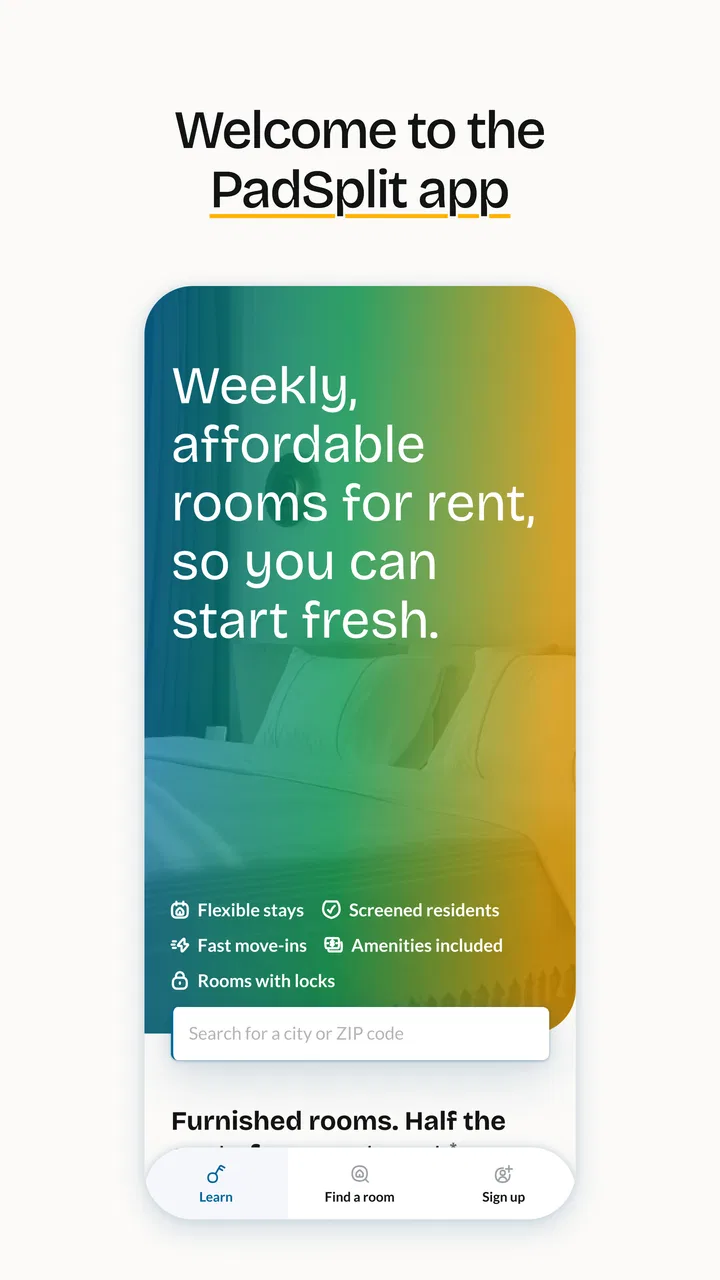
PadSplit: Rooms for rent
- 4.5
- Rating
- 100.00K
- Installs
- Free
- Price

 Analysis by App-foxy
Finding a room can be harder than finding a whole apartment, especially when a full lease, large deposit, or traditional application process is out of reach. PadSplit: Rooms for rent takes a different approach by focusing on shared housing rather than asking renters to search only for complete apartments. I see that as its most important capability: it turns the search toward individual rooms and budget-conscious living arrangements, which can make the first step feel more realistic for someone who does not need or cannot afford an entire place.
I reviewed PadSplit as a House & Home app from PadSplit, and my overall impression is that it is most useful when your priority is finding a practical room quickly, not building a long list of conventional apartment options. It is free to install, available to users rated Everyone, and has built a solid audience with a 4.6 average from roughly 4.1 thousand ratings and more than 100 thousand installs. Those figures do not replace personal research, but they do suggest that the app is addressing a real housing need rather than being a novelty.
Why the room-focused approach matters
The central idea is simple but meaningful: instead of beginning with the question, “Which entire apartment should I rent?”, you begin with, “Which room and shared home could work for me?” That change in perspective matters for people moving to a new area, starting over, working with a tight budget, or needing a place without taking on the responsibility of a full household.
You May Also Like

 Blood Strike: 2.5 Anniversary
Blood Strike’s Loadouts Turn Every Drop Into a Tactical Gamble
A close look at Blood Strike’s custom loadouts: how fast access to signature weapons reshapes its battle royale rhythm, rewards preparation, and narrows the gap between fights.

 Pandora - Music & Podcasts
Pandora’s Music Is Easy to Start, but Harder to Recover
Pandora’s strength is its low-effort path from a seed to a station. Its weak spot is how much confidence it asks you to place in connection, setup, and quiet recovery.

 8 Ball Pool
 Is Built on Rivalries, Rematches, and Routine
A close look at the rivalries, rematches, shared routines, and unanswered safety questions that turn a quick pool match into a persistent mobile community.

 Samsung Music
’s Quiet Strength Is Playing What You Already Own
Its reach comes less from spectacle than from dependable access to a personal library. That simplicity is both the app’s strongest retention engine and its ceiling.

 AccuWeather: Weather Radar
AccuWeather Review: A Quick, Clear Forecast for Everyday Decisions
For everyday plans, the best forecast is the one you can understand quickly. AccuWeather makes rain timing, radar, and local conditions easy to act on, with a few trade-offs.

 Hill Climb Racing
Why Hill Climb Racing Still Turns Crashes Into One More Run
A tiny car, a bumpy hill and one more upgrade: Hill Climb Racing keeps resurfacing because its simple chaos makes every near-miss feel personal.
More From Our News Desk
View All News


In my experience, ordinary rental searches often create a mismatch between what a person needs and what the market displays. Full apartments may offer privacy, but they can also bring higher upfront costs, more space than necessary, and a longer list of obligations. A room-rental service narrows the search to a more attainable type of housing. PadSplit’s store summary describes its purpose as innovative, budget-friendly housing, and the app’s room-centered identity follows that promise more closely than a general property browser would.
The biggest practical benefit is not simply seeing rooms; it is starting with a housing format that may already fit your financial and everyday situation. If you live alone, spend most of your time at work, or need a place to sleep and reset rather than a complete private apartment, that focus can save time. It also helps set expectations early. You are not opening the app expecting a standard apartment marketplace and then discovering that most options are unsuitable.
That focus also makes the app less useful for certain renters. If you need an entire home for a family, require a private kitchen and living room, or want to negotiate directly around a conventional long-term lease, a traditional rental platform may be a better starting point. PadSplit is not attractive because it does everything; it is attractive because it concentrates on one housing problem.
What I look for before taking a room seriously
A room listing can look appealing at first glance, but the right decision depends on details that are easy to overlook when you are focused on finding something affordable. I would treat the app as the beginning of a careful comparison process, not as permission to accept the first available option.
First, I would compare the room’s location with my actual routine. A low-cost room can become expensive in practice if it adds long commutes, difficult transfers, or frequent ride costs. I would check the route to work, school, grocery stores, medical appointments, and any place I visit every week. This is one of the less obvious trade-offs of budget housing: the advertised saving may be reduced by transportation.
Second, I would think about shared living as a daily experience rather than an abstract feature. The important questions are whether I am comfortable sharing common areas, how much privacy I need, and whether I can follow household expectations. A room may solve the immediate need for shelter while still being a poor match for someone who works night shifts, needs quiet during the day, or strongly prefers controlling the entire living environment.
Third, I would keep a written checklist while browsing. I would note the location, the room’s apparent condition, the shared spaces, the move-in requirements shown in the listing, and any questions that need an answer before applying. This prevents the most attractive-looking option from winning simply because it was the first one I saw. It also makes comparisons easier when several rooms appear similar.
Using it in a realistic everyday situation
Imagine someone accepting a job in a new city with little time before the start date. Renting a complete apartment may require more money, furniture, and planning than that person has available. With PadSplit, the search can begin around rooms in shared homes, allowing the renter to consider a smaller personal space instead of trying to solve every housing need at once.
In that situation, I would use the app during a short, focused search session. I would begin with the area around the workplace, then widen the distance only if the commute remains manageable. I would save or note promising rooms, compare the practical details, and eliminate anything that creates a serious problem with transportation or privacy. After that, I would inspect the requirements carefully and prepare questions before making a commitment.
The useful insight here is that the app works best as a filter for realistic possibilities, not as a substitute for judgment. Its value is greatest when it helps you move from “I need housing” to a smaller group of room options that fit your situation. The final decision still requires attention to the property, the shared arrangement, and the terms involved.
A similar scenario applies to someone leaving an unstable living arrangement. That person may not be in a position to furnish an apartment or wait through a lengthy search. A room-focused service can make the search feel more direct, but speed should not remove caution. I would still verify the location, understand what is included, and make sure the arrangement suits my routine before treating it as a solution.
Where the experience can feel limited
The same specialization that makes PadSplit useful can also make it restrictive. A room is not the same as an apartment, and shared housing requires compromises that are not visible in a short summary. You may have less control over noise, guests, storage, cleaning, and the use of common areas. Even a well-presented room can feel wrong if the household rhythm conflicts with yours.
There is also an emotional trade-off. Some renters enjoy the social side of shared housing, while others find it tiring to return home and still have to navigate other people’s habits. I would not recommend choosing this type of housing solely because it appears cheaper. The arrangement needs to fit your personality and schedule. Someone who values maximum privacy may save money but lose comfort.
Another limitation is that a room search can encourage tunnel vision. When the goal is to find an affordable place, it is easy to focus on the room itself and ignore the broader cost of living. I would consider transportation, food access, laundry, furnishing needs, and the time required to reach essential services. These factors can change whether a room is genuinely convenient.
Compared with a conventional apartment marketplace, PadSplit is more focused but less appropriate for broad property shopping. A general platform is usually the better option when you want to compare studios, complete apartments, houses, and different lease styles in one search. PadSplit makes more sense when you already know that a room in shared housing is a serious possibility.
Compared with informal room listings on social networks or community boards, a dedicated app can provide a more organized place to begin searching. However, organization alone should not be mistaken for a guarantee that every option will match your needs. I would still apply the same caution I use with any housing search: read carefully, ask direct questions, and avoid making decisions based only on photos or a low apparent cost.
Questions I would answer before applying
One question many renters have is whether the app is suitable for someone who needs a complete private home. In my view, it is not the natural choice for that purpose. Its identity is built around rooms for rent and budget-friendly shared housing, so anyone requiring a full apartment should compare other services at the same time rather than relying on PadSplit alone.
Another question is whether it works for a short-term transition. It can be worth considering when you need a room while changing jobs, relocating, or rebuilding your housing situation, but the suitability depends on the specific arrangement and its requirements. I would never assume that “room for rent” automatically means flexible timing. I would read the available terms closely and confirm anything that affects move-in, payment, or length of stay.
People also ask whether the app removes the need to inspect a property. It does not. A digital listing can help you discover an option, but it cannot replace checking the neighborhood, understanding the shared spaces, and making sure the room matches your expectations. If an in-person visit is not practical, I would at least gather enough specific information to judge the location and living arrangement before committing.
For users wondering whether the app costs anything to download, PadSplit is free. That makes it easy to add to a housing search without paying simply to explore the service. Still, free access to an app should not be confused with free housing. The room itself and any associated requirements remain the important financial questions, so I would focus on the complete cost of the arrangement rather than the download price.
Finally, I would ask whether it is suitable for every age group. The app carries an Everyone content rating, which makes it broadly accessible as an app. That rating does not decide whether a particular room is appropriate for a person’s household, income, schedule, or housing needs. Those decisions still require individual judgment.
Small habits that make the search more useful
My first tip is to search from your routine outward rather than from the cheapest-looking option inward. Start with the places you must reach regularly, then consider rooms that keep those trips reasonable. This avoids choosing a room that appears affordable but creates a daily burden.
My second tip is to separate “must have” requirements from preferences. A safe-feeling location, workable commute, adequate privacy, and manageable shared spaces belong in the first group. Paint color, decorative style, or a slightly larger room may belong in the second. This makes it easier to judge listings consistently and reduces the chance of rejecting a practical option for a minor reason.
My third tip is to prepare questions before contacting anyone. I would ask about the areas I would share, what furniture is present, how storage works, what the household routine is like, and which costs or responsibilities I should plan for. These questions are more useful than simply asking whether a room is “nice,” because they connect the listing to everyday life.
My fourth tip is to think about an exit plan. Even if the room seems ideal, I would want to understand what happens if my job changes, my commute becomes unreasonable, or shared living no longer works. A budget-friendly decision is stronger when it remains manageable under ordinary changes in life.
Who is most likely to benefit
PadSplit is a strong candidate for renters who are deliberately considering shared housing and want a focused way to look for rooms. It may help people relocating for work, individuals who do not need a full apartment, and renters trying to reduce the pressure that comes with furnishing and maintaining an entire home.
It can also suit someone who wants to compare practical housing options without beginning with luxury features or excess space. If your priorities are location, basic livability, and a manageable arrangement, the app’s narrow focus may be more useful than a large marketplace filled with properties you would never consider.
On the other hand, I would point families, people who need complete privacy, renters with highly specific accessibility requirements, and anyone seeking a conventional apartment toward broader housing services as well. PadSplit should be part of their search only if a room in a shared home remains genuinely acceptable.
The app runs on Android with a minimum operating system requirement of version 8.0, and its current version is 1.7.3. It was released on February 24, 2021, and the continued presence of a substantial rating base gives it a degree of familiarity among people exploring this type of housing. I would still keep the app updated and treat the latest listing details as more important than assumptions based on an older search.
My recommendation after using the room-first approach
PadSplit: Rooms for rent is worth trying when the room itself is the solution you are looking for. I like that it does not force every renter into the traditional apartment model. By centering the search on shared housing, it can make a difficult housing problem feel more concrete and may help users discover options that a standard apartment search would place outside their budget or priorities.
My recommendation comes with a clear condition: use it as a focused discovery tool, then slow down for the decision. Compare the commute, consider the realities of shared spaces, check the full financial picture, and ask questions that reveal how the arrangement will work on an ordinary Tuesday, not just how it looks in a listing.
For me, that balance is what gives the app its value. It is not a universal replacement for apartment-search services, and it should not be treated as one. But for the renter who wants a room, needs a budget-conscious path, and is prepared to share a home responsibly, PadSplit offers a relevant starting point that is much more specific than a general housing catalog.
FAQs for PadSplit: Rooms for rent
01What is PadSplit and how does it work?
PadSplit is a platform designed to provide affordable housing solutions by offering rooms for rent in a shared living environment. Users can browse available rooms, view details, and apply directly through the app. PadSplit manages the rental agreements and payments, streamlining the process for both hosts and members.
02How does PadSplit ensure the safety and security of its members?
PadSplit takes safety seriously by performing background checks on all members before approval. Additionally, the platform facilitates communication with hosts and provides clear guidelines and rules for all members to follow. This ensures a safe and respectful living environment for everyone involved.
03What are the costs associated with using PadSplit?
PadSplit offers an affordable housing solution with rent typically covering utilities, internet, and furnishings. There are no long-term lease commitments, but members pay a weekly rental fee. An initial membership fee may also be required. Specific costs vary based on location and room features.
04Can I choose my roommates on PadSplit?
While PadSplit does not allow you to select specific roommates, it does provide detailed profiles of potential housemates. This includes information on their lifestyle and preferences, helping you make informed decisions about your living situation. PadSplit aims to match compatible members to ensure a harmonious living environment.
05What happens if I need to move out of my PadSplit room early?
PadSplit offers flexibility with no long-term lease obligations. If you need to move out early, you are generally required to provide a notice period as specified in your membership agreement. This flexibility allows members to adapt to changing circumstances without the worry of hefty penalties.
Pros
- Easy booking process for rooms.
- Affordable pricing options available.
- Flexible lease terms offered.
- User-friendly interface design.
- Responsive customer support team.
Cons
- Limited availability in some cities.
- May encounter shared living challenges.
- No mobile app
- only web-based.
- Background check required for signup.
- Strict guest policies in place.

PadSplit: Rooms for rent
Gallery